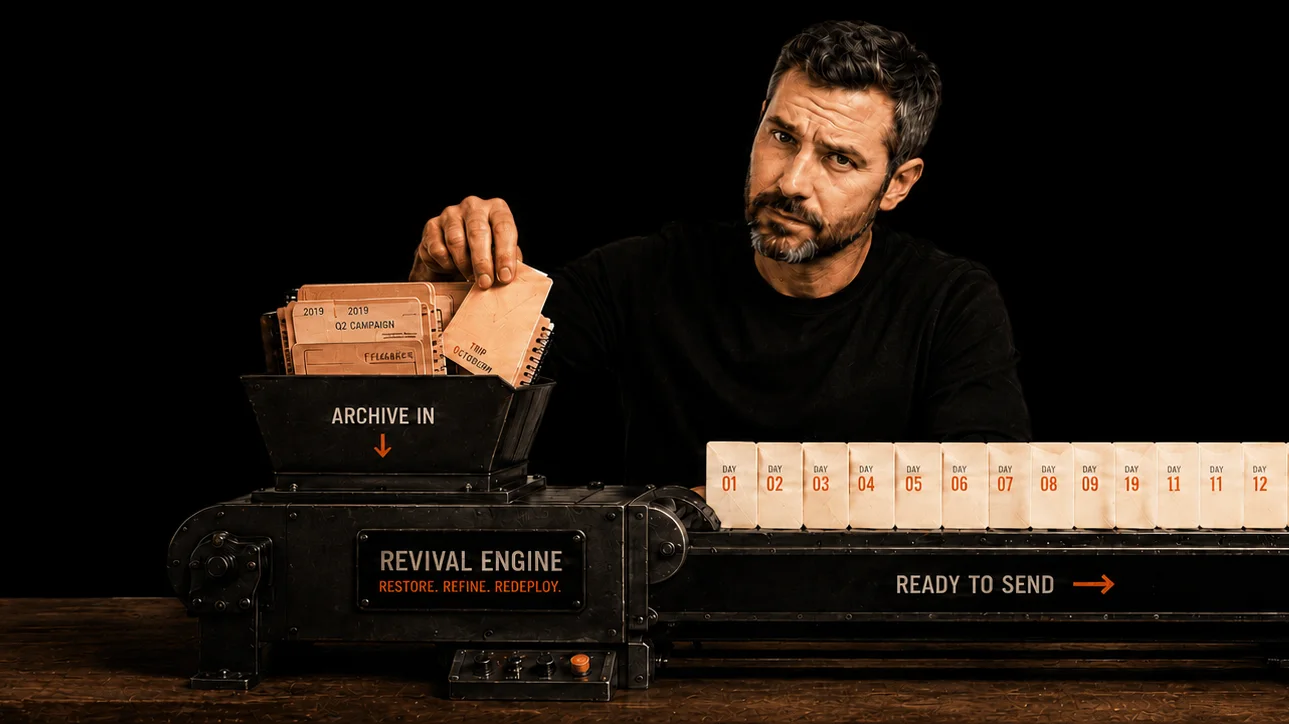
6 call recordings. 4 hours and 54 minutes of audio. In about 20 minutes they became 6 rows in a table.
All 6 rows still said Not Started.
That's the honest state of transcript to content AI for most coaches and consultants, including me on that particular Thursday. The harvesting is easy now. The mining is where everyone stops. So this post is about both halves, because the second half is the one that makes your group calls into marketing.
TLDR
- Every group call you've recorded is a marketing asset sitting in a folder nobody opens.
- What comes out of a call never comes out of a draft: your rhythm, your refined explanations, objections in the client's own words.
- A summary hands you prose. A schema hands you something you can count. Build the schema.
- One client's 5 years of calls became 6 months of email topics, approved almost on sight.
- Harvested is not mined. The table is not the work.
The Recording Folder Is Where Marketing Goes to Die
One coach I work with runs 16 to 20 coaching calls a week. Every one of them records. Every one of them drops into a folder. And until we built the layer that made them queryable, every one of them was unreachable. Not lost. Unreachable, which is worse, because you know it's there.
Meanwhile the same person is scrambling for something to post on Tuesday. That's the gap. The best explanation of your framework you've ever given happened on a Wednesday group call in March, to 14 people, and it will never be heard again.
I've made the argument in stop starting fresh that the material already exists. This post is about the specific kind of material a group call produces, because it's different from anything you'd sit down and write.
What Comes Out of a Call That Never Comes Out of a Draft
You write like a professional. You talk like yourself. The system wants the second one, and a group call is the second one at its best, because you're explaining things to people who are confused in real time.
- Your actual rhythm. Sentence length, where you pause, what you repeat when you want something to land.
- The 200th explanation. The version of your core idea that you've refined by saying it out loud to confused people for 3 years. No draft has that polish.
- Objections in the client's own words. "But what if my clients won't pay that" is a better headline than anything a copywriter would invent, and it's in your transcript already.
- The asides. The jokes. The part where you say "look, honestly" and then say the true thing. That's the voice people buy.
I watched a coach run a 5-day live class recently and logged what got engagement. The pattern: comments spiked every time he mentioned a case study or a number. Those are the high-intent people, actively listening. The moments that lit up the chat are the moments that should become posts, and they're timestamped in the recording.
6 Recordings, 14 Fields, 20 Minutes
Here's the harvesting half, the part that's easy now.
Those 6 recordings, a group call at 1 hour 7 minutes, an implementation session at 1 hour 6, and 4 one-to-ones from 21 minutes to 1 hour 27, went into a table between 5:11pm and 5:32pm. Each row is not a summary. It's 14 fields: key points, quotable moments, email angles, social post points, tools mentioned, and a content status that says whether anything's been made from it yet.
The schema is the trick. A summary hands you prose you have to read again before you can use it. A field hands you something you can count. Across those 6 rows I could see that a particular tool got mentioned on 3 calls, a reservations platform on 2, a POS on 1. I could not have counted that out of nearly 5 hours of audio without sitting through nearly 5 hours of audio.
If you build 1 thing this month, build the schema. 14 fields is mine. Yours might be 8. The point is that every call lands in the same shape, so the sort works across all of them.
From 5 Years of Calls to 6 Months of Emails
Now the mining half, with the clearest example I have.
A client had been coaching for over 5 years. Before I joined, the approach to email topics had been: research what matters to the audience, generate 50 topics, pick the best, write emails. The emails sounded generic, because the topics came from research rather than from him.
So we flipped it. We took all of his coaching call transcripts, distilled them to the topics he was actually covering week after week, and the questions his clients were actually asking. Then we cross-referenced those topics back against the transcripts and pulled out his own statements, in his own words, on each one. That became the reference library.
Out of that came roughly 6 months of email topics, and his reaction was, close to verbatim, that these were exactly the things he wanted to be talking about. The writing was approved almost immediately. As a content writer that never happens. It happened because the topics were already his. All we did was find them.
That is the Encode step pointed at a recording folder, and it's the basis of the Nurture Engine: sequences built from what you already said to the people who already paid you.
Harvested Is Not Mined
I'll end where I started, because it's the part I'm least proud of.
Those 6 rows sat at Not Started. The audio was sortable, the schema was right, and not one row had been turned into anything. I built the intake and the intake is not the work. The work is the second pass: pick the row, pull the quotable moment, run it through the voice skill, ship it. That pass needs a slot in the week or it doesn't happen. Mine is now Friday.
So if you have a folder of recordings, you are not behind. You are sitting on the best marketing material you'll ever own. You just haven't built the table, and you haven't booked the Friday.
If any of this sounds like your recording folder, it's probably worth a conversation. Or test it directly: send me 1 recording. A group call, a one-to-one, anything you said. You get a finished asset back in your voice within 48 hours, and you'll see what was sitting in the folder the whole time.
FAQs about turning coaching calls into content
How do I turn coaching call recordings into content?
Transcribe every call into the same schema: key points, quotable moments, email angles, social angles, tools mentioned, and a content status. Then run a weekly pass that picks a row, pulls the strongest moment, and produces the asset through a voice skill built from your own material. The schema makes the calls sortable. The weekly pass makes them content.
Are group coaching calls better content sources than one-to-ones?
Usually, for marketing. Group calls carry the explanations you have refined by repeating them and the objections raised in clients' own words, both of which are stronger hooks than anything drafted fresh. One-to-ones hold more client specifics that need redacting. Both work. Group calls need less cleanup.
What if my calls are confidential?
Your own talk tracks, explanations, and framing survive redaction. Client specifics get stripped at the transcript stage before anything enters the reference library. What the system needs is how you think and speak, not who you said it to.
How many recordings do I need to start?
4 to 6 mixed recordings is enough to build a Voice Print and start producing. A client with 5 years of calls produced roughly 6 months of email topics from the archive, but the first assets came from a handful of calls, not the whole folder.